Getting Ready for AI Shopping & Discovery
Insight
27 Mar 2026
7 min read
The way consumers discover and buy products online is undergoing its most significant shift since the arrival of mobile commerce. All predictions suggest that shoppers will increasingly turn to AI assistants - tools like Claude, ChatGPT, Gemini, Copilot, and Perplexity - to find, compare, and even purchase products directly within a conversation, rather than typing keywords into a traditional search engine. This shift is accelerating fast, particularly in North America (or for merchants selling into North America). Shopify reports that AI-referred traffic to merchant stores has grown roughly nine times over the past year, and orders attributed to AI-driven searches have increased around fifteen times since early 2025. A recent Shopify survey found that 64% of shoppers said they are likely to use AI in some form when making purchasing decisions. McKinsey projects that agentic commerce could drive up to $1 trillion in US B2C retail revenue by 2030. Whilst we’re not fully convinced that consumer behaviour will adapt that quickly; a lot of the core actions that are being suggested to get “AI-ready” are actually just Best Practice for merchants wanting to operate a well-structured Shopify store. As a result; we’ve pulled together some guidance on the key actions you can take, to get ahead of the curve for if/ when AI shopping takes off.
This article sets out what’s happening, why it matters, and the practical steps you can take today to make sure your store and your brand are ready.
What Is Agentic Commerce?
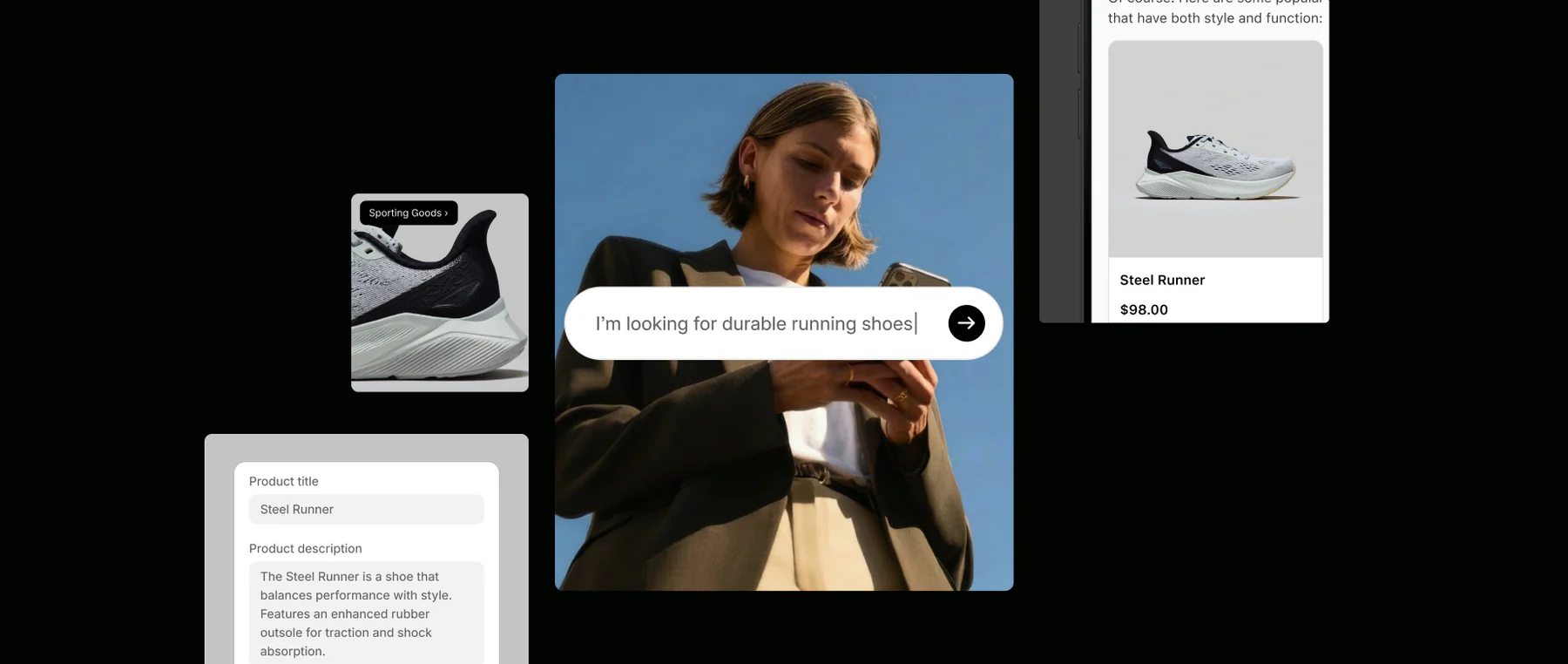
Agentic commerce refers to a new model of online shopping where AI agents, rather than real folk, handle parts of the buying journey. Instead of a customer browsing your website, clicking through collections, and adding items to a cart; an AI assistant interprets their intent, searches across multiple brands, presents tailored recommendations, and in some cases completes the purchase entirely within the chat interface.
For example, a shopper might say to ChatGPT: “I’m looking for a premium scented candle as a gift and I have £30 to spend. Ideally a British brand with sustainable packaging/ethics and the Mrs will like that”
The AI then searches product catalogues, reviews, brand information and editorial content to provide a specific recommendation. In certain territories/ on certain platforms; users can now link directly to checkout or even process the transaction in-chat.
Shopify has been at the forefront of enabling this. Their Agentic Storefronts feature connects your product catalogue directly to AI platforms with a single setup in your Shopify admin. They have also co-developed the Universal Commerce Protocol (UCP) with Google, an open standard that allows AI agents to discover products, build carts, and complete checkouts across any merchant.
What Is GEO (Generative Engine Optimisation)?
You will already be familiar with SEO; optimising your website to rank well in search engine results. GEO is its evolution for the AI era. Generative Engine Optimisation is the practice of ensuring your brand and products are discoverable and accurately represented when consumers use AI tools to search and shop.
When someone asks an AI assistant a product question, the AI doesn’t simply return a list of links. It breaks the query into multiple sub-searches, gathers data from across the web and from direct API feeds, collates the results, and provides a single, curated answer. If your product data, brand presence, and SEO fundamentals are not in order, you simply will not appear in that answer. That’s an opportunity missed.
Shopify’s GEO Playbook identifies three pillars of AI visibility that every brand needs to get right. We have summarised these below with practical guidance tailored to our clients.
Pillar 1: SEO Fundamentals
AI chatbots rely heavily on traditional search engine results as inputs for the answers they generate. Strong rankings in Google (other search engines are available 👀 ) directly increase your chances of being cited in AI responses. Most of the foundational SEO work you have already invested in transfers directly to AI visibility.
What To Review
Product titles and descriptions: Ensure these are clear, specific, and attribute-rich. AI agents need literal, descriptive language rather than creative marketing copy. “Lightweight women’s waterproof hiking boot” is far more useful to an AI than “Walk On Clouds.”
Title tags and meta descriptions: Make sure every page has unique, descriptive title tags and headings. These help both search engines and AI understand what each page delivers.
Robots.txt and sitemap: Check that your robots.txt is not blocking pages you want AI to find, and that your sitemap includes a complete, up-to-date list of live pages. Policies, FAQs, size guides, and shipping information are all pages that AI agents actively look for.
Content quality: Create pages that directly answer the questions buyers are asking. Detailed buying guides, comparison content, and thorough product information all contribute to AI visibility.
Pillar 2: Brand Authority
Your brand matters more in the AI era, not less. AI tools want to recommend trusted brands, and they assess trust through a combination of authority, reputation, relevance, and visibility across the web. Only some of what AI considers comes from your website - the rest comes from everywhere else: reviews, press coverage, community discussions, social media, and editorial mentions.
What To Review
Ask the AI about yourself: Open ChatGPT, Claude or Gemini and ask: “What does the internet say about [your brand name]?” Note which pages it references. Check whether the information is accurate and up to date. If it references pages you own, correct any outdated information. If it references outside sources, make sure you have comparable, accurate content on your own site.
Reviews and social proof: Invest in generating authentic customer reviews, user-generated content, and community engagement. AI actively synthesises these signals when deciding which brands to recommend.
PR and editorial coverage: Press mentions, influencer partnerships, and appearances in reputable publications all contribute to your brand’s authority in the eyes of AI systems.
Consistency across channels: Make sure your brand story is told consistently across your website, social profiles, YouTube, and any other owned channels. AI draws from all of these.
Shopify Knowledge Base App: This allows you to upload FAQs, return policies, shipping information, and brand voice guidelines so that AI agents give accurate, on-brand answers about your products. It is free for Shopify Plus merchants and £40/month on standard plans.
Pillar 3: Data Quality
This is the pillar that separates the brands who show up in AI from those who don’t. There is a gap between what looks good on a product page for a human shopper and what an AI agent can actually consume and act on. Clean, structured, machine-readable product data gives AI the raw material it needs to recommend you confidently.
What To Review
Complete your primary data fields: Titles, descriptions, variant options, images, prices, and product taxonomy should all be filled out completely using specific, literal language. These are the fields AI agents rely on to surface and sell your products.
Use specific product taxonomy: Assign the most specific product type or category possible. “Women’s waterproof hiking boots” rather than just “footwear.” The more specific your taxonomy, the more accurately AI can match your products to relevant queries.
Group variants correctly: If the same product in five colours exists as five separate products in your data, an AI agent may not know they are related. Group variants under a single parent product so AI sees one product with options.
Ensure data consistency: AI agents cross-reference your structured data against your storefront. If your data says one thing and your product page says another, this can be treated as a trust issue. Make sure pricing, availability, and product details are consistent across all surfaces.
Clean up metafields and custom data: If your product information is stored in custom fields, use Shopify’s Catalog Mapping tool to ensure this data is correctly sourced for AI channels.
Leverage Shopify Catalog: Shopify’s Catalog automatically syndicates your product data to AI platforms via direct API. When AI agents pull from a trusted API with real-time pricing and inventory, they prioritise that data over web scraping every time. This is a significant advantage for brands on Shopify.
Agentic Storefronts: What You Need To Know
Shopify’s Agentic Storefronts is the mechanism that connects your store directly to AI shopping platforms. It is being rolled out to eligible merchants and is active by default for qualifying stores. Here are the key things to understand:
You remain the merchant of record. You retain full ownership of the customer relationship and post-purchase experience, just as with orders placed on your online store.
Orders flow into your Shopify admin. All orders from AI channels appear in your admin with full channel attribution so you can see exactly where each order originated.
You control which channels you sell through. You can toggle individual AI platforms on or off in your admin, and control visibility on a per-product basis.
Discovery happens regardless. Your products are already discoverable by AI channels through web crawling and indexing. Opting out of Agentic Storefronts only disables native checkout within AI chats - it does not prevent your products from being recommended.
Eligibility is expanding. As of March 2026, Agentic Storefronts with native checkout are available to eligible US-based stores selling to US customers. For UK merchants, your products are still discoverable via AI, and native checkout capabilities are expected to expand internationally. The preparation steps outlined in this document apply to all stores regardless of current eligibility.
Your Action Plan
Based on everything above, here is a prioritised action plan that we recommend all of our clients work through. These steps will improve your AI discoverability today and ensure you are well-positioned as agentic commerce scales throughout 2026 and beyond.
Immediate Actions (This Month)
Audit your product data for completeness: titles, descriptions, images, variant options, pricing, and taxonomy. Fill any gaps with specific, literal language. Review your robots.txt to ensure it is not blocking pages that AI should be able to access. Ask your preferred LLM what it knows about your brand and note any inaccuracies or gaps. Install and configure the Shopify Knowledge Base App with your FAQs, policies, and brand voice guidelines.
Short-Term Actions (Next Quarter)
Review and improve product taxonomy across your entire catalogue, assigning the most specific categories possible. Consolidate any variants that are modelled as separate products. Ensure your structured data (schema markup) is consistent with what appears on your product pages. Review your content strategy to include buying guides, comparison content, and detailed product information that directly answers customer questions.
Ongoing Actions
Continue investing in brand building: reviews, PR, community engagement, and consistent storytelling across all channels. Monitor your AI visibility by regularly searching for your brand and product categories in Claude, ChatGPT, Gemini, and Perplexity. Track orders and traffic attributed to AI channels in your Shopify admin as these features roll out. Keep your product data fresh. AI agents deprioritise products with stale, incomplete, or conflicting information.
How Say Yes Can Help
We are actively working with our clients to prepare their stores for this shift. Whether it’s auditing and restructuring product data, implementing the Knowledge Base App, reviewing your technical SEO foundations, or developing a content strategy that supports AI discoverability, we are here to help you navigate this transition.
The brands that move first will capture a disproportionate share of this new channel. As Shopify themselves have noted, nobody has a perfect playbook …yet. The early movers who experiment, iterate, and invest in quality will be the ones who win, just as they did in the early days of SEO.
If you would like to discuss how any of this applies to your brand specifically, or if you’d like us to run an AI readiness audit on your store, please don’t hesitate to get in touch.
Author

Phil Clark
Managing Director
Phil is an eCommerce growth leader, known within the industry as friendly and approachable - with a wide industry knowledge across all facets of eCommerce, build and digital/ retail operations.
Is your store ready for Agentic Shopping?
Book an intro with Say Yes to find out.
Related Insight
All insights
Follow us